Double Claw Machine ROI: How Two-Player Cabinets Change Revenue per Square Meter
A two-player cabinet does not double your revenue, it doubles your stations per square meter. This article compares footprints, explains where pair demand actually comes from, builds a three-scenario payback model with stated assumptions, and sets out the three situations where a double is the wrong purchase.
- 1. The Only Metric That Separates Good Locations from Bad Ones
- 2. Footprint Comparison: One Double Versus Two Singles
- 3. Where Two-Player Demand Actually Comes From
- 4. A Three-Scenario Payback Model
- 5. The Costs That Double With the Stations
- 6. Which Locations Justify a Double
- 7. When the Double Is the Wrong Buy
- 8. Decision Checklist
- Conclusion
A double claw machine puts two player stations in one cabinet. The investment question is not "does it earn twice as much as a single", because it usually does not. The question is whether it earns more per square meter of prime floor than the alternatives competing for that same space. This article builds that comparison and shows where the two-player format wins.
If you have not yet settled the basic cabinet choice, start with the commercial claw machine buying guide. Everything below assumes you already know you are buying claw machines and are now deciding the format.
1. The Only Metric That Separates Good Locations from Bad Ones
Revenue per machine hides the cost of the space it stands on. Two venues can run identical machines at identical daily takings while one is highly profitable and the other is marginal, because one pays mall-grade rent and the other pays for a corner of a warehouse.
The working metric is:
Revenue per square meter per month = (coin-in − prizes − direct costs) ÷ (floor area + operating clearance)
Everything that follows uses this measure. It changes the answer in three specific ways:
· A cabinet with more stations per square meter is favoured.
· Space that already exists inside a paid footprint is valued at the rent you are paying for it, not at zero.
· A second cabinet on new floor has to beat the rent of that floor, not just its own cost.
2. Footprint Comparison: One Double Versus Two Singles
The physical argument for the two-player format is straightforward.
|
Configuration |
Stations |
Floor Footprint |
Clearance Zone |
Total Space |
|
Two single cabinets, side by side |
2 |
~0.93 m² cabinet area |
~1.6 m² |
~2.5 m² |
|
One two-player cabinet |
2 |
~0.81 m² cabinet area |
~1.1 m² |
~1.9 m² |
Two singles need a gap between them for access and door swing, and each needs its own front clearance. A double cabinet shares one front clearance zone between both stations, because players stand shoulder to shoulder rather than in two separate queues.
The saving is modest on paper — roughly 20–25% of the total space — but in a mall atrium or a cinema lobby, that recovered half square meter is often the difference between fitting a third attraction or not.
The second, less obvious advantage: a double cabinet produces one visual mass instead of two separate objects. A single cabinet reads as furniture. Two stations in one lit cabinet with a shared prize chamber reads as a destination, which is what pulls a group of four friends across a concourse.
3. Where Two-Player Demand Actually Comes From
Doubling stations only helps if pairs arrive together. In practice, four demand patterns do the work:
1. Couples and dates. Two people, one shared experience, twice the session length of a solo player.
2. Parent and child. The parent plays, the child directs. This pattern alone justifies a second station in family venues.
3. Friend pairs. The competitive element — "you try" — converts one purchase into two or three.
4. Queue compression. At peak times, a second station halves wait time, which reduces walk-aways. This is the single most underrated financial effect of the format.
The fourth point deserves emphasis. Operators usually model a double as "twice the capacity". In a high-traffic venue it is better understood as "fewer lost customers at peak". Peak-hour walk-aways are invisible in your transaction data and large in your revenue.
4. A Three-Scenario Payback Model
The model below is illustrative. Substitute your own rent, machine cost and observed play rate; the structure is what matters. All figures exclude rent, which is treated separately as a space cost.
Stated assumptions: price per play equivalent to 2 currency units; prize cost at 25% of coin-in; power, consumables and maintenance at 8% of coin-in; one attendant hour per day across a small cluster.
|
Scenario |
Plays/Station/Day |
Coin-in/Day |
Net After Prizes & Ops |
Annual Net |
Payback on Machine |
|
Conservative |
25 |
100 |
67 |
~24,400 |
~3.0 years |
|
Base |
50 |
200 |
134 |
~48,900 |
~1.5 years |
|
Strong |
90 |
360 |
241 |
~88,000 |
~0.8 years |
Two things to read from this table rather than the payback figures:
· Payback is dominated by plays per station, not by machine price. Moving from conservative to base triples nothing and halves everything; the difference between a mediocre position and a good one dwarfs any negotiation on unit price.
· The conservative case still works, slowly. A double in a secondary position is not a disaster, it is a three-year asset. That is acceptable if the space is free and unacceptable if you are paying atrium rent for it.
Run the model with your own numbers before ordering. If your venue cannot credibly reach base-case plays per station, the correct purchase is one single cabinet in a better position, not a double in a worse one.
5. The Costs That Double With the Stations
Two stations do not double every cost, but they increase several:
· Power. A two-station cabinet draws more than a single, typically in the 150–350 W band depending on lighting and model, so electricity planning must account for the cabinet, not per station.
· Prize restocking labour. A shared chamber empties faster. Expect restock frequency to scale with total plays, not with cabinet count.
· Maintenance frequency. Two gantries, two claws, two control channels. Failure probability per cabinet is higher than for a single even though it is lower than for two separate singles.
· Repair downtime impact. When a double fails, two stations go dark, not one. This argues for keeping the shared control components as stocked spares.
· Placement constraints. A wider cabinet needs a wider egress-safe position and a flatter floor. Some lobby corners will not take it.
6. Which Locations Justify a Double
The format earns its premium in five settings:
· Mall atriums and concourses where foot traffic passes on two sides and groups form naturally.
· Cinema lobbies before peak screenings, where pairs and families wait together.
· Large FEC anchor zones, as the visual centrepiece of a prize area.
· Bowling and sports entertainment venues, where groups arrive as fours and sixes.
· Indoor playground exits, where parent-child pairs leave together.
Conversely, a double is hard to justify in a narrow retail aisle, a restaurant waiting area with one bench, or any position where players stand in single file against a wall. In those places a compact mini unit in two separate spots outperforms one wide cabinet.
7. When the Double Is the Wrong Buy
Three honest disqualifiers:
5. Your site cannot fill one station. If a single cabinet in that position runs below 25 plays per station per day, a second station will split the same demand.
6. Your space is genuinely free. If the alternative use of that floor is nothing, a second single cabinet costs less and fails independently.
7. Your maintenance capability is thin. One cabinet failing takes out both revenue streams. If you cannot service on-site within 24 hours, redundancy beats density.
8. Decision Checklist
✔ Model revenue per square meter, not revenue per machine.
✔ Confirm the position can reach base-case plays per station before sizing up.
✔ Count peak-hour walk-aways at your existing cabinets.
✔ Check floor level, door swing and egress width for a wider cabinet.
✔ Stock shared spares: gantry bearings, claw coils, control board.
✔ Compare against the compact alternative in the mini range before committing prime floor.
Compare two-station models in the double claw crane machine range. For the operating side of the same decision — how to keep a wide cabinet fed and serviced — read preventive maintenance for commercial claw machines.
Conclusion
A two-player cabinet is a space-efficiency purchase, not a capacity purchase. It wins where floor is expensive, groups arrive together, and peak-hour walk-aways are real. It loses where demand is thin enough that a second station only divides the same players.
Model it on revenue per square meter, hold the machine to your own play-rate evidence rather than a supplier's projection, and treat the second station as a bet on group behaviour. When the behaviour is there, the format pays back roughly twice as fast per unit of floor as the single cabinet it replaced.
Capsule and Blind Box Claw Machines: Custom Grid Layouts, Prize Modules and OEM Production Planning
Mini Claw Machine Placement: Turning Dead Space into Daily Revenue in FECs, Cinemas and Retail Stores
Single Claw Crane Machine Buying Guide: Cabinet Specs, Claw Assemblies and Inspection Points
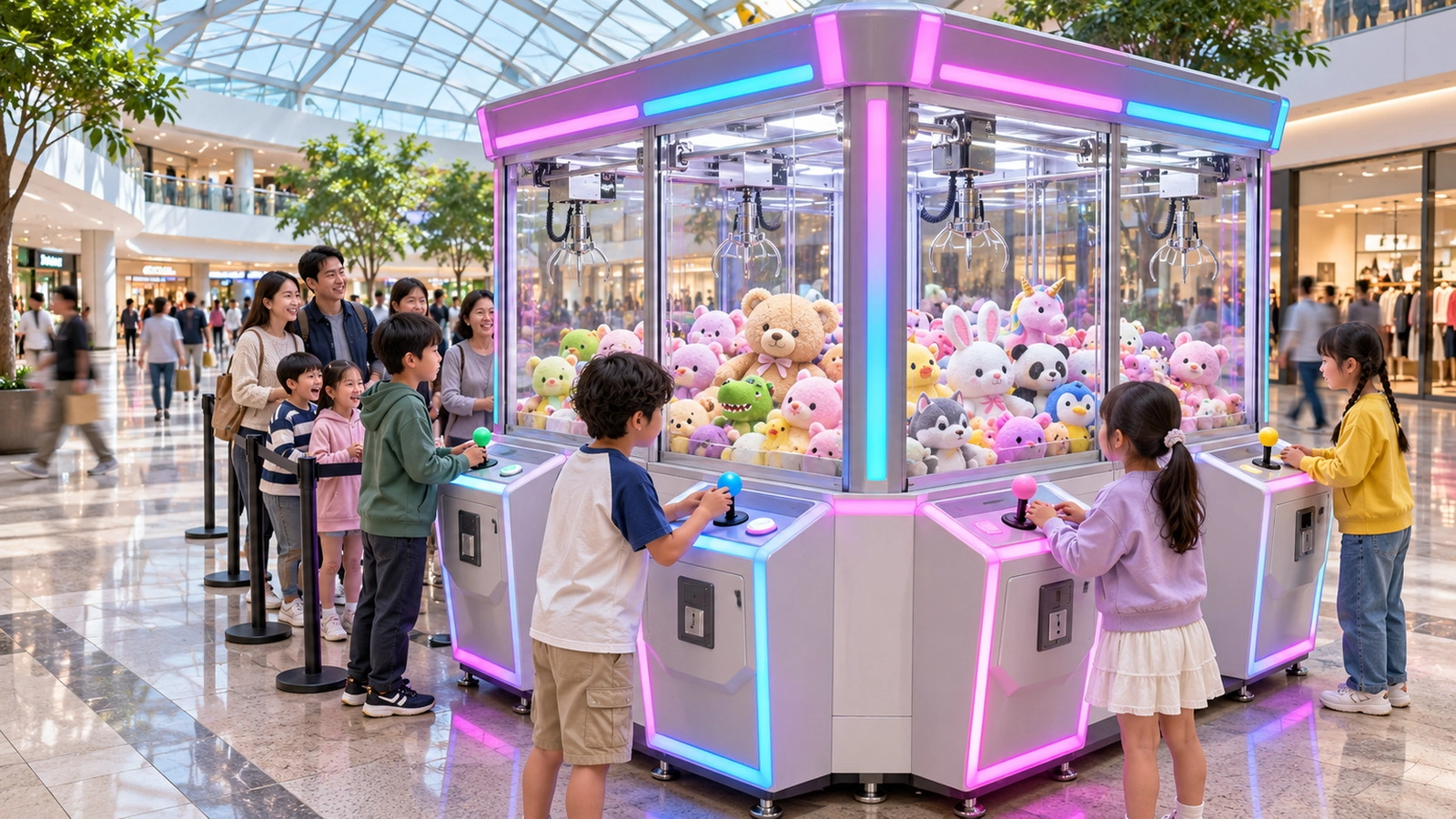
Operating a 4-Player Claw Machine: Throughput, Queue Flow and Prize Replenishment
claw machine
Do you provide after-sales support?
Yes. As a professional claw arcade machine supplier, we provide full after-sales service, including:
- Technical support
- Spare parts supply
- Installation guidance
- Maintenance assistance
Our support team ensures your claw machines operate smoothly.
What is a claw machine?
A claw machine is an arcade game where players control a mechanical claw to grab prizes such as toys, plush dolls, or capsules. Claw arcade machines are commonly found in arcades, shopping malls, and family entertainment centers.
What types of claw machines do you offer?
We offer a wide range of claw arcade machines, including:
- Standard claw machines
- Mini claw machines
- Giant claw machines
- Capsule claw machines
- Custom claw machines
- Prize vending claw machines
All machines are designed for arcade venues and commercial use.
How profitable is a claw machine business?
The claw machine business is one of the most profitable arcade businesses.
Many operators place claw machines in:
- Shopping malls
- Game arcades
- cinemas
- amusement parks
- family entertainment centers
With the right location and prizes, claw machines can generate stable daily income.
Do you sell claw machines wholesale?
Yes. Marwey specializes in claw machine wholesale and global distribution.
Our machines are widely used by:
- Arcade centers
- Family entertainment centers
- Amusement parks
- Game distributors
- Claw machine arcade businesses
We support bulk orders and long-term distributor cooperation.
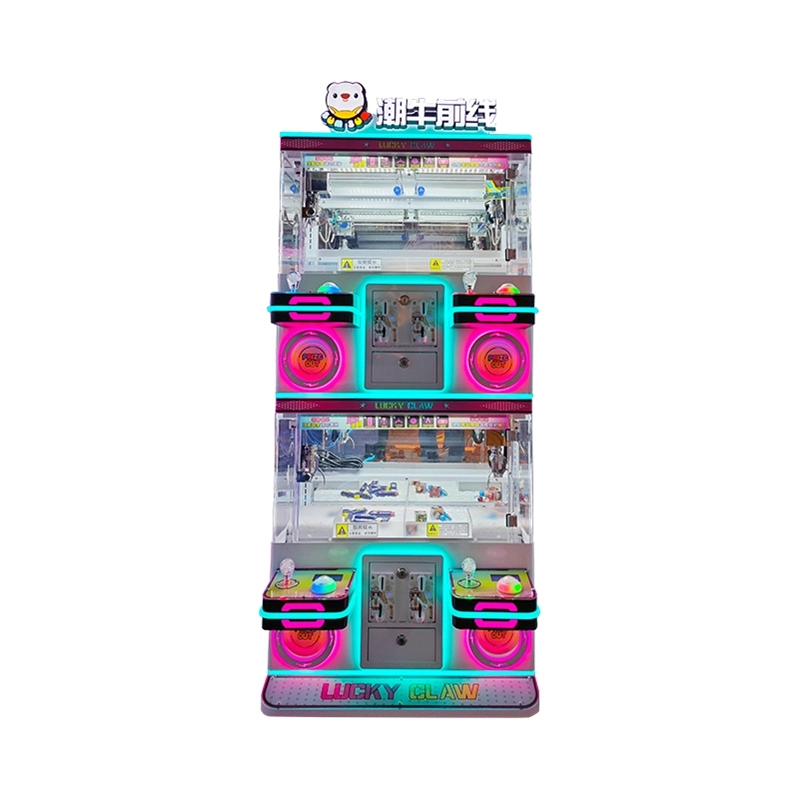
Mini 4 Players Commercial Arcade Claw Machine Coin Operated Plush Toy Prize Catcher Doll Game Machine
Discover the commercial 4-player coin-operated claw crane machine, perfect for arcades. This claw machine arcade offers thrilling prize-catching fun with plush toys, boosting engagement and revenue. Durable and easy to operate, it’s a top choice for claw crane machine entertainment.
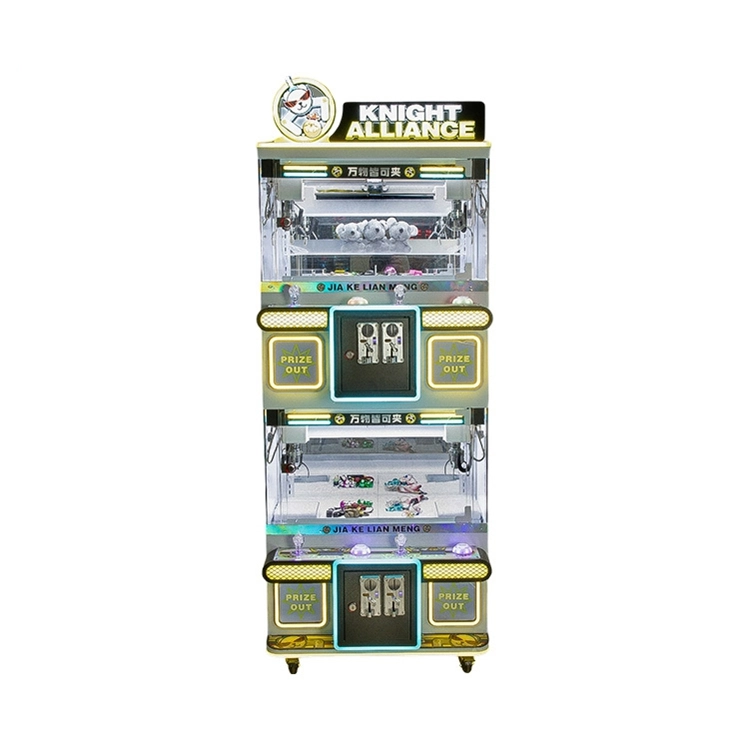
4-Player Mini Claw Crane Arcade Machine Gift Doll Catching Machine for Sale
Discover the 4-player catch doll machine, a mini claw crane prize machine perfect for fun and gifting. This claw game machine offers exciting multiplayer action, making it ideal for entertainment venues and events. Buy now for endless claw game fun!
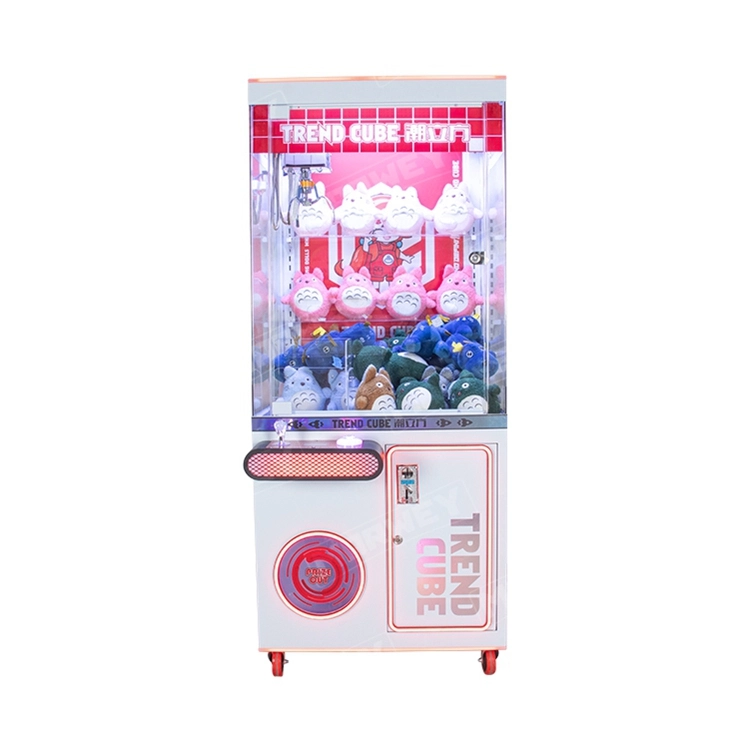
Wholesale Amusement Park Claw Machine Coin Operated Toy Crane Arcade Machine
Discover the toy crane machine, a high-quality claw machine arcade perfect for amusement parks. This coin-operated claw machine offers endless fun and excitement, making it an ideal wholesale choice for businesses seeking reliable, engaging entertainment solutions.
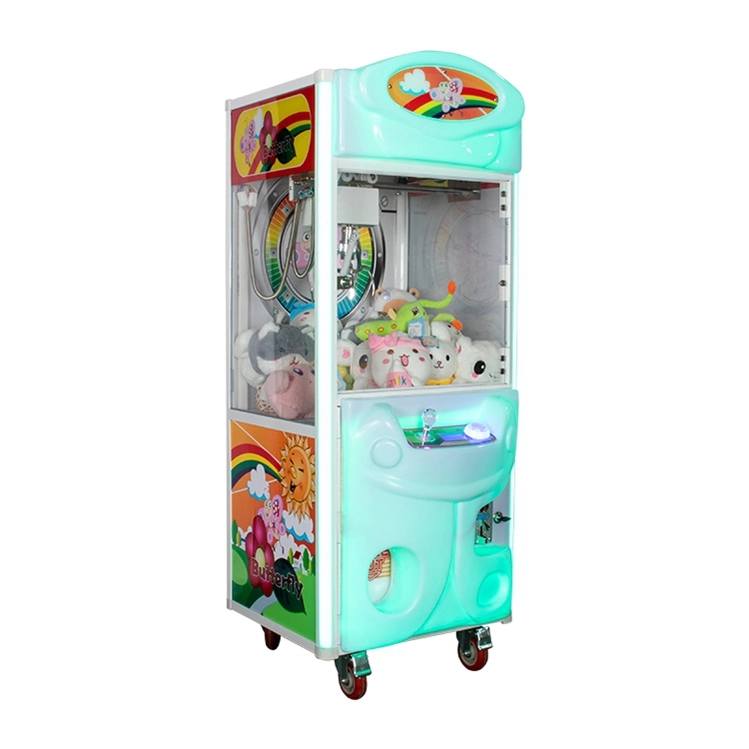
Wholesale Custom Indoor Claw Crane Machine Coin Operated Arcade Doll Catcher Machine
Discover wholesale arcade claw crane machine — customizable, indoor, and coin-operated. Perfect as a small crane claw machine, it offers endless fun and engagement. Ideal for businesses seeking a reliable small claw machine to boost customer interaction and revenue.
Marwey
MarweyArcade
marwey_arcade
Arcade Marwey
Marwey Amusement
Whatsapp: +8618922184260